

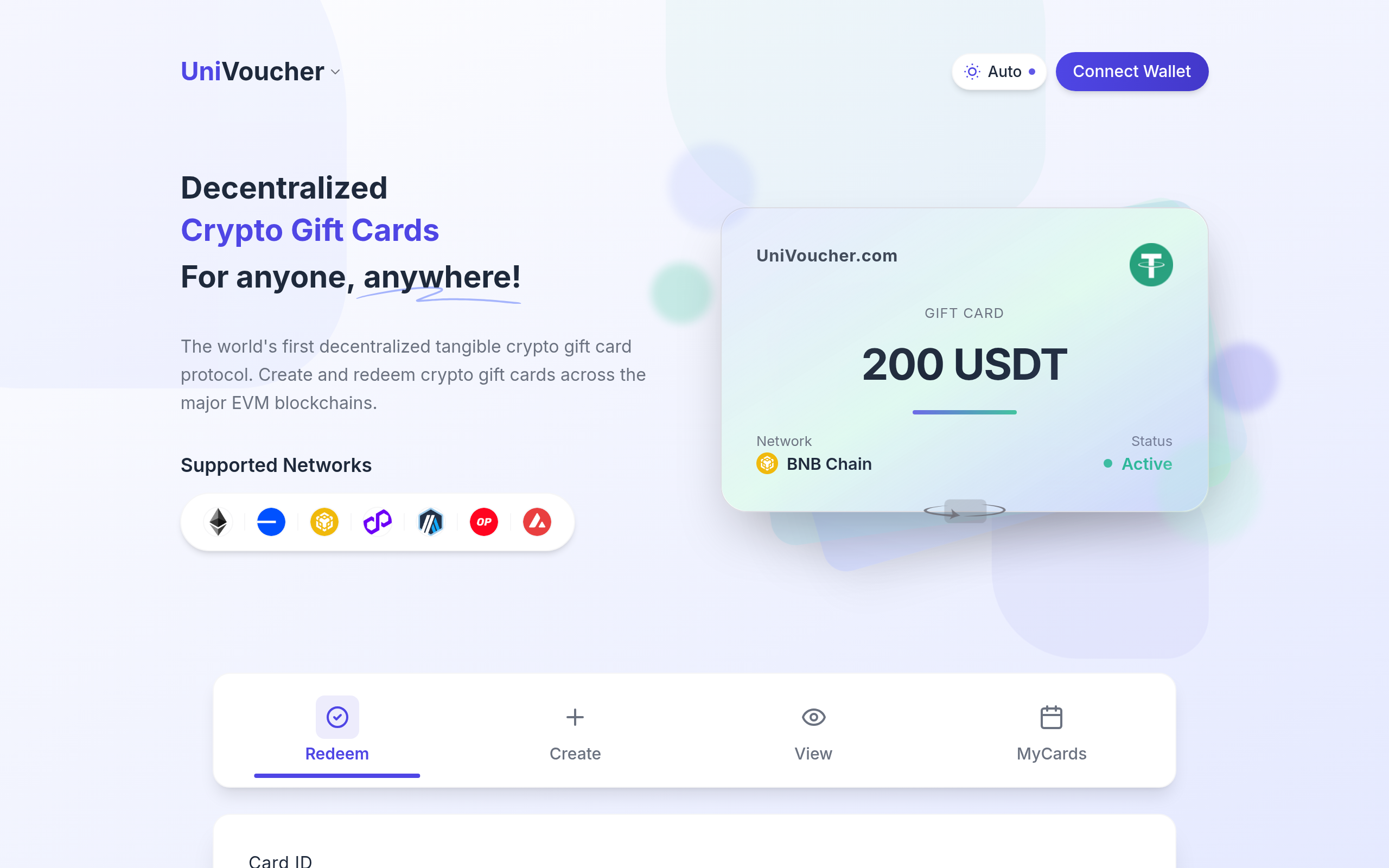
Description
UniVoucher is a fully decentralized, open-source protocol for tangible crypto gift cards, letting anyone gift any token in any amount across the major EVM chains — Ethereum, Base, BNB Chain, Polygon, Arbitrum, Optimism and Avalanche.
How it works
- Connect a wallet, choose a native coin or ERC-20 token (USDT, USDC, DAI and others), set an amount and a card message.
- The protocol issues a Card ID and a 20-character Card Secret (XXXXX-XXXXX-XXXXX-XXXXX) that can be printed, handwritten or shared digitally.
- The recipient enters both to claim the funds. No account registration is required.
Key features
- Fully on-chain: card data settles on-chain with verifiable proof and no central database.
- Non-custodial; creators can cancel unredeemed cards to reclaim funds.
- Public API, developer docs, an MCP server and a WooCommerce plugin.
Use cases: gifting crypto, event rewards, promo codes, and onboarding people who don't have a wallet yet.
Highlights
Pros
- Creators can cancel unredeemed cards and reclaim funds, including bulk cancellation, from a "My Cards" dashboard that shows status across all supported chains.
- Genuine token flexibility — any native coin or ERC-20 token in any amount across Ethereum, Base, BNB Chain, Polygon, Arbitrum, Optimism and Avalanche.
- Independently audited contracts (SafetyBytes, Valves Security) with verified, publicly readable source code on every supported chain.
- Fully on-chain and non-custodial: card data and funds live in a verified smart contract, not a company database, so there's no platform-held balance.
- Developer-friendly for merchants: free public API, full docs, a WooCommerce plugin and an MCP server with no approval or partnership gatekeeping.
- No signup or KYC-style onboarding: connect a wallet and create or redeem in a few steps using a simple Card ID plus 20-character secret.
Cons
- EVM-only coverage — Bitcoin, Solana and Tron (TRC-20) are unsupported, so assets on those chains can't be gifted at all.
- Cards are bearer instruments: anyone holding the Card ID and secret can redeem them, and a lost secret leaves recovery to the creator cancelling the card.
- Card management is wallet-bound — you must reconnect the exact wallet used to create or redeem, with no email login or account recovery option.
- Standard redemption needs a Web3 wallet plus gas on the card's network; gasless redemption depends on the third-party Redeem Base, not the protocol itself.
- No direct purchase flow on the site: buying a pre-funded card means going through third-party resellers like G2A, Kinguin or BuySellVouchers.
- Deliberately no social media or community channels — support runs through a contact form only, with no live chat or public troubleshooting space.