
Description
Purpose
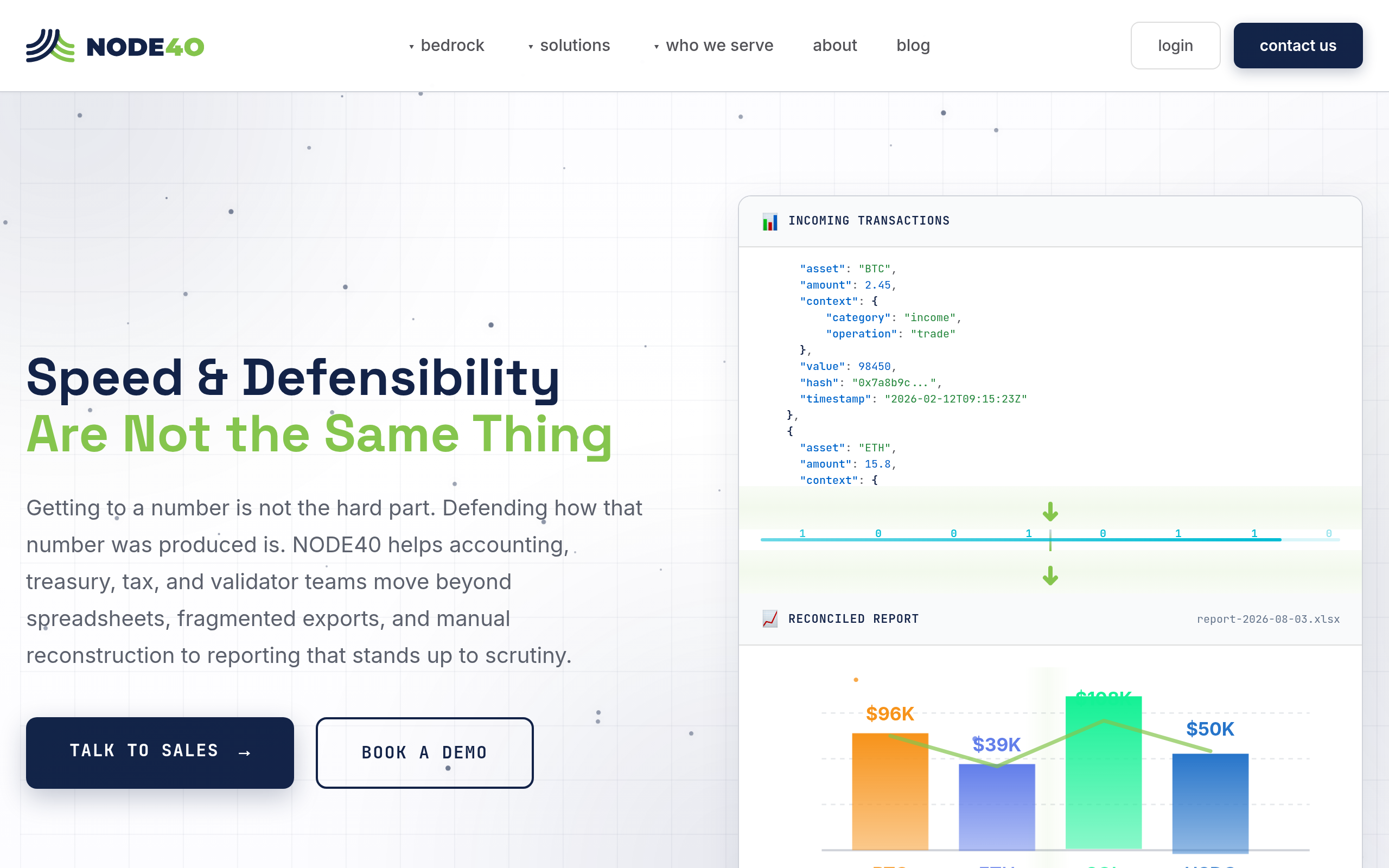
NODE40 is an enterprise crypto accounting, tax, and audit platform that turns crypto activity into explainable, defensible records.
Key Features
- 20+ blockchains — on-chain and off-chain data across Ethereum, Solana, Bitcoin, and more
- Tax liability — IRS-compliant cost basis and capital gains calculations
- Verifiable audit trails — SOC1-compliant reporting from cost basis to disposition
- Accounting & reconciliation — track and reconcile assets across wallets and exchanges
- DeFi context — protocol-aware labeling of DeFi transactions
- NODE40 Bedrock — governed treasury accounting with lot-level tax decisions and audit controls
Main Use Cases
- Accounting firms and wealth managers preparing defensible reporting
- Treasury teams governing lot selection and period close
- Exchanges and high-volume traders tracking cost basis across chains
Highlights
Pros
- Bedrock's governed lot-intelligence layer makes lot selection team policy — standing orders, protected lots, and pinned lots, with every decision and its rationale recorded on the record.
- First consumer crypto tax platform to achieve SOC 1 Type I audit accreditation (SSAE 18), independently audited by Armanino LLP since 2019.
- Protocol-aware DeFi reporting parses complex transactions into separate financial events across 50+ protocols, tracking smart-contract functions and wrapped/LP token derivation.
- Supports the IRS-approved SpecID tax-lot method plus FIFO, LIFO, and HIFO, with a cost-basis tracking process granted patent-pending status by the USPTO.
- Audit-first architecture: every transaction carries verifiable blockchain references (hash, block number) and third-party USD valuations, with an append-only audit trail built for IRS audit defense.
- Deepest Solana coverage in the category — validator epoch-reward accounting, Jupiter swap routing, and SPL token analysis, with 1B+ Solana transactions processed.
Cons
- Blockchain coverage tops out at 20+ networks versus rivals like Cryptio at 50+, and niche or obscure chains require case-by-case verification of support.
- Independent reviews are nearly nonexistent: TrustRadius lists a single 9.0/10 rating and SourceForge has zero user reviews, leaving third-party validation thin.
- The record is append-only with hard-closed periods, so correcting reported history requires governed override workflows rather than simple edits.
- ERP integrations are narrow — only QuickBooks and Xero have native connectors, while NetSuite and Sage Intacct require custom integration work.
- Strictly enterprise and sales-led: there is no self-serve signup, and every path funnels into a sales demo, making the platform impractical for individual users.