

Description
Purpose
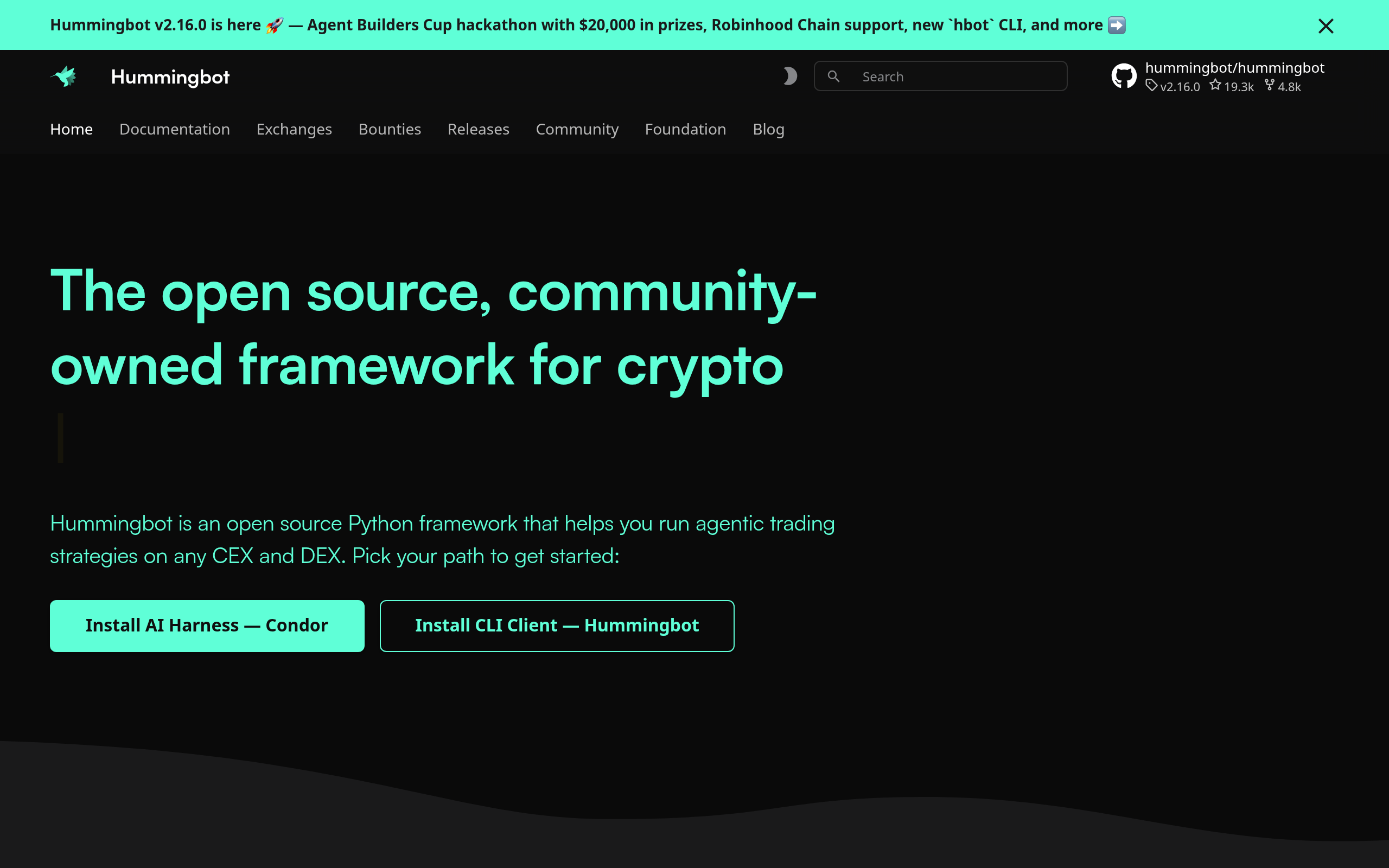
Hummingbot is an open-source, community-owned Python framework for building and deploying algorithmic trading strategies — from market making to arbitrage — on centralized (CEX) and decentralized (DEX) exchanges. All code is released under the Apache 2.0 license and maintained by the Hummingbot Foundation together with a global community of developers and algo traders.
Key Features
- 300+ exchange connectors — standardized connectors to CEXs and AMM DEXs across major blockchains
- Modular strategy framework — build strategies with scripts and controllers, with built-in backtesting
- Gateway — middleware that connects bots to DEXs and blockchain networks
- Dashboard & Hummingbot API — web interface and API for deploying and managing multi-bot setups
- Condor — open-source AI harness for building and running agentic trading strategies
- Fully open source — Apache 2.0 licensed, with rich documentation, Discord community, and Botcamp training
Main Use Cases
- Automated market making and liquidity provision on CEXs and DEXs
- Arbitrage and other custom algorithmic strategies
- Academic research and strategy backtesting
- Learning algorithmic trading through the official Botcamp program
Highlights
Pros
- Local-client design encrypts API keys with a master password and never sends them to third-party servers — keys are only used to sign exchange requests.
- Deep customization via Python strategy scripting — fine-grained control over spreads, order sizes, inventory limits, and quoting frequency, plus ready-made market-making and arbitrage presets.
- Learning ecosystem includes Botcamp courses, extensive documentation, and collaboration with academic institutions like Cornell University.
- 318 exchange connectors spanning centralized venues and DEXs (Binance, Coinbase, KuCoin, Uniswap, PancakeSwap, and more), letting one bot run across many markets.
- Reported real-world scale: 111K+ Hummingbot instances and $47B+ in aggregated trade volume tracked since January 2025.
- Fully open-source Python framework (Apache 2.0, under the Linux Foundation umbrella) with ~19.3k GitHub stars, making the entire codebase publicly auditable.
Cons
- No built-in P&L dashboard — users must export CSV logs and run their own analysis to gauge performance.
- Command-line-only interface with no graphical dashboard or mobile app — hands-on reviewers describe it as a "builder's kit" rather than a plug-and-play tool.
- Connector reliability depends on community patches — reviewers observed the Binance connector desync during a volatility spike before auto-reconnecting ~15 seconds later.
- Self-hosted by design — users must deploy and monitor their own VPS or hardware, handle server security, and keep software updated.
- Steep learning curve: reviewers estimate 5–10 hours to master the CLI workflow, and users must understand concepts like spread, fill rate, and inventory skew.
- No recent comprehensive external audit of the main codebase — the only published audit (2022, of Hummingbot Miner) found a critical vulnerability, leaving production security largely to users.