

Description
Purpose
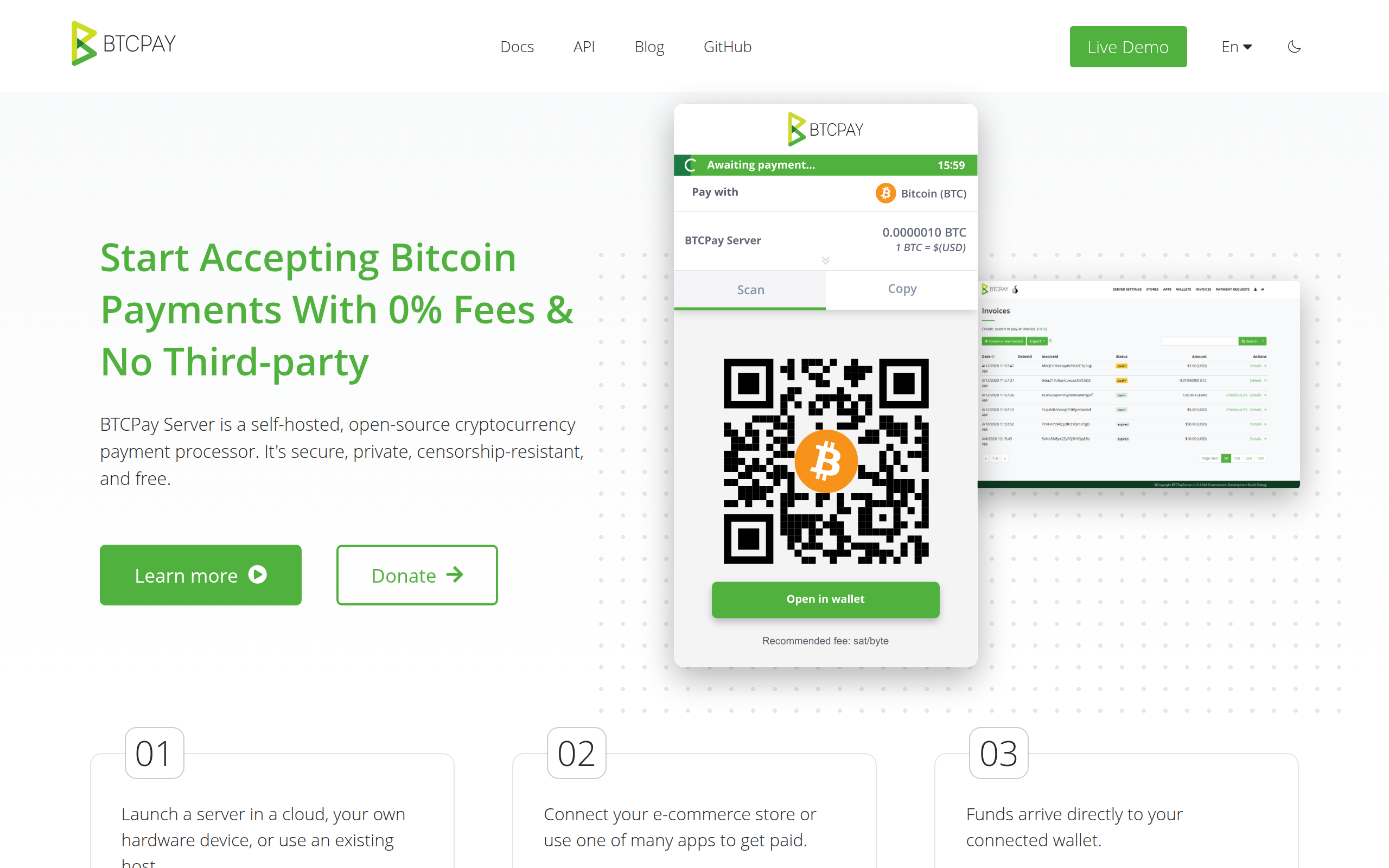
BTCPay Server is a self-hosted, open-source cryptocurrency payment processor for merchants who want to accept Bitcoin with 0% fees and no third party. Payments go directly to the merchant's own wallet, keeping full control, privacy, and censorship resistance.
Key Features
- 0% fees, no middleman — funds arrive straight from the customer to your wallet
- Self-hosted or shared — run it on your own hardware, in the cloud, or on a shared server
- Built-in apps — point-of-sale, payment links, tipping buttons, and crowdfunding campaigns
- Native wallet management — store and manage received funds inside the server
- E-commerce integrations — WooCommerce, Shopify, Magento, PrestaShop, and many more
- API automation — full REST API for invoicing and payment workflows
Main Use Cases
- Accepting Bitcoin payments in online and brick-and-mortar stores
- Sending payment links and invoices to clients worldwide
- Running crowdfunding campaigns and community fundraisers
- Adding tipping and donation buttons to websites
Highlights
Pros
- Open-source under the MIT license with 7,700+ GitHub stars and 200+ contributors, so the payment-processing code is fully auditable.
- Built-in point-of-sale, crowdfunding, donation-button, and payment-request apps, plus invoice management and a full-node wallet with hardware-wallet integration.
- Self-hosted with no KYC: merchants run their own server, own their keys, and no third party can freeze or seize payments.
- Non-custodial design sends payments directly from the customer's wallet to the merchant's wallet — no intermediary ever holds funds.
- Native Lightning Network support across LND, Core Lightning, and Eclair backends enables instant Bitcoin payments.
- Plugins for WooCommerce, Shopify, Magento, PrestaShop, and 20+ other platforms, plus a BitPay-compatible legacy API that eases migration from BitPay.
Cons
- No native fiat settlement — merchants receive crypto directly and handle conversion to fiat on their own.
- Self-hosting demands real technical skill — deployment, server maintenance, and software updates all fall on the merchant.
- No built-in subscription or recurring billing, so merchants needing recurring payments must build around the platform.
- Initial setup includes syncing a full Bitcoin node, which can take days before payments can be accepted.
- No dedicated customer support — help comes from community chat, GitHub, and documentation rather than a support desk.
- The official build supports Bitcoin only; altcoins (LTC, XMR, ETH) require a separate community-maintained build, and stablecoins like USDT/USDC aren't supported.